
Classic Car Storage

Classic Car Storage You Can Trust
Preserving Classic Cars with Expert Care in Manchester
Classic cars deserve more than standard storage – they require an environment that respects their history and preserves their condition. At Pitstop 66, our classic car storage in Manchester, provides secure, humidity-controlled storage designed specifically for vintage, heritage, and collector vehicles, ensuring they remain protected, maintained, and ready to enjoy.
- Prevent rust, fading, and deterioration with stable conditions.
- Specialist technicians ensure your classic stays road-ready and authentic.
- Tailored preservation programs designed for vintage and collector vehicles.
Best Services
8-Step pre-storage process
Whether it’s a classic, an exotic supercar, or a vehicle with deep sentimental value, we care for your car as if it were our own.
- Condition photographed
- Car ID & Keys tagged
- Interior protected
- Careful washed
- Tyre pressures increased
- Allowed to fully air dry
- Battery & fluids checked
- Brake disc clean

Condition photographed
Tyre pressures increased
Car ID & Keys tagged
Interior protected
Meticulously washed
Battery & fluids checked
Allowed to fully air dry
Brake disc clean
Care That Goes Beyond Storage
Our specialist care programme ensures your classic remains in peak condition during extended periods off the road. We provide battery trickle charging and tyre pressure checks as standard, while engine run-ups, servicing coordination, and mechanical support are included in our Gold and Platinum packages and available as optional extras with any plan.
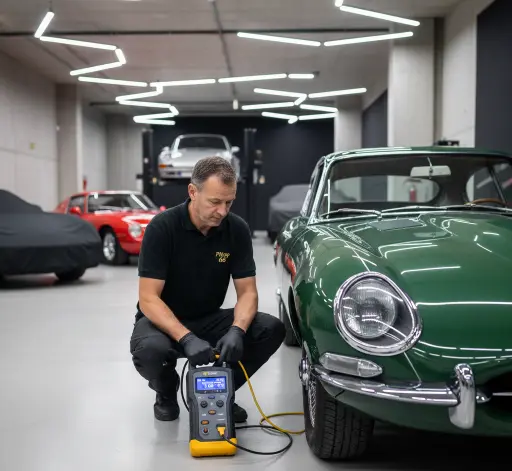
Our facility also features a fully equipped on-site workshop, staffed by engineers with decades of experience working on classic and performance vehicles. This means we can carry out mechanical checks, adjustments, and pre-storage inspections without the need to move your car off-site, offering additional reassurance that your vehicle is always in expert hands.
For added reassurance, our enhanced packages also offer detailed condition reporting, professional detailing, and covered transport, ideal for concours vehicles or cars stored long term.
Designed for Collectors and Enthusiasts
Whether you’re storing a family classic, a concours-winning show car, or an appreciating investment, Pitstop 66 offers a service built around your needs. Flexible terms, transparent pricing, and personalised care plans are all part of our commitment to exceptional service.
Our classic car storage in Manchester is ideally placed to serve clients across the North West, including Cheshire, Wilmslow, Hale, Alderley Edge, and beyond.
Speak to our team today to discuss your requirements or arrange a visit to our facility.
What actually damages a classic in storage
Very little of it is dramatic. A classic rarely fails in storage, it degrades, quietly, in four specific ways, and every one of them is a function of the air around the car rather than the car itself.
Moisture in the air. Above roughly 60% relative humidity, condensation forms on cold metal and stays there. It collects inside sills, along chassis rails, on the inner faces of wheel arches and across brake discs, all the places nobody inspects until something fails an MOT. Older cars are worse affected because the underseal is usually decades old and the panels were never galvanised.
Air that is too dry. The opposite problem, and the one people never anticipate. Below about 45% relative humidity, leather loses its oils and cracks along the seat bolsters, rubber door and window seals harden and shrink, and timber in a dashboard or door capping can split. A heated garage with no humidity management does this reliably over a winter.
Standing still. Tyres flat-spot where the weight sits, brake discs bond lightly to the pads, seals dry where they are not in contact with oil, and the battery discharges past the point of recovery. None of it is inevitable, but all of it happens by default.
Nobody looking. A slow coolant weep, a rodent nest in the airbox, a tyre losing pressure, these are trivial if caught in a week and expensive if found in April. This is the failure that has nothing to do with the building and everything to do with whether anyone walks the floor.
How we store a classic
Our humidity-managed area is held at 55% relative humidity, deliberately between the two failure points above. It is measured rather than assumed, which is the distinction worth pressing any facility on.
Every car goes through the same eight stages when it arrives, before it goes anywhere near a bay:
- Condition photographed, so there is a record neither of us can argue with
- Keys and vehicle ID tagged
- Interior protected
- Washed thoroughly, road salt and traffic film left on paint over a winter cause their own damage
- Tyre pressures raised above road pressure to spread the load and prevent flat spots
- Left to air dry completely, because a car put away damp stays damp
- Battery and fluid levels checked
- Brake discs cleaned
After that, someone lays eyes on the car every day it is with us. A breathable cover and an automatic battery conditioner are available and come with the premium package.
Should a stored classic be started periodically?
Our view, which is not universal: no, not unless it is being driven properly afterwards.
Starting an engine and idling it for ten minutes brings it to temperature without ever getting the oil hot enough to boil off the water and fuel that combustion puts into it. That contaminated oil then sits in the sump against bearing surfaces until the next time. Cold starts also drag unburnt fuel down the bores, washing the oil film off the cylinder walls.
A stored car is better left alone in a stable environment with the battery conditioned than woken up once a month. If it is coming out, take it out properly and get it hot. Otherwise leave it be. We cover this in more detail in how often to start a stored car.
What it costs, and what you get back
Classic storage with us is £150 a month for the first three months and £165 after that on the standard indoor tier, or £200 then £225 with managed humidity. Both include VAT, the minimum stay is one month, and we collect within 65 miles by arrangement.
For most classics we would recommend the humidity-managed tier. The £50 difference is small against a single set of cracked seat bolsters or a corroded set of discs, and on a car with original paint, chrome or leather it is the whole point of storing it properly.
Condition records go with the car. If you sell it, a documented storage history with dated photographs is worth real money at auction, something we go into in how storage records affect resale value.
Classic Car Storage: Further Reading
Classic vehicles ask more of a storage facility than modern cars do. Older seals, thinner paint protection and period electrics all react badly to damp.
Our classic car storage guide covers condition and value protection in detail. A common worry is answered in will my classic car deteriorate during long-term storage.
Before the cold sets in, work through preparing a classic car for winter storage, or see winter car storage in Manchester. To reserve a bay, enquire here or call 0161 464 7494.
Choosing Where a Classic Is Stored
Distance is the wrong test for a car that will not move for six months. The air around it matters far more than the postcode.
Our piece on classic car storage near me sets out what an older car is actually vulnerable to. Before it goes in, why a car should be cleaned before storage is worth five minutes.
Collection runs to 65 miles by arrangement. Reserve a bay or call 0161 464 7494.