
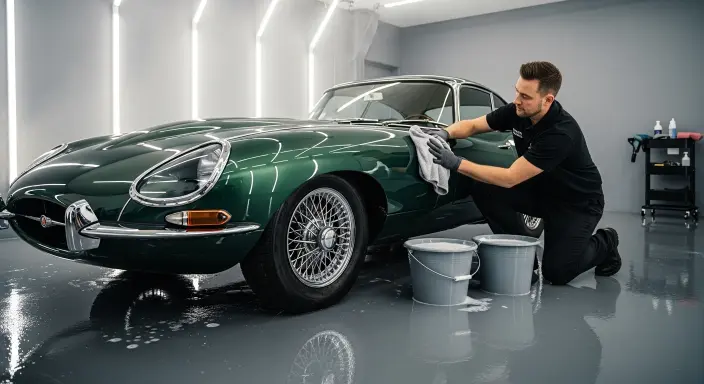
For many owners, the shine of a classic car is part of its soul. But maintaining that deep gloss – and protecting the metal beneath – requires more than an occasional wash. Proper bodywork care helps prevent rust, fading, and other age-related wear that can quietly reduce a car’s value over time.
At Pitstop 66, we see first-hand how regular, careful attention preserves both appearance and condition. Whether you look after your car at home or trust it to our classic car storage facility in Manchester, these bodywork care tips will help keep it in top form.
Wash Carefully and Regularly
Classic paint finishes and older chrome parts are far more delicate than modern ones. Always start with a gentle rinse to remove dust and debris before contact washing. Use a pH-neutral shampoo, a soft mitt, and the two-bucket method to avoid swirl marks.
After rinsing, dry with a clean microfibre towel – not a chamois, which can drag dirt and cause fine scratches.
At Pitstop 66, every vehicle receives a gentle pre-storage wash in our dedicated valeting bay, using premium products designed specifically for classic and prestige paint finishes.
Wax for Protection, Not Just Shine
A good wax or sealant does far more than enhance gloss – it creates a barrier against UV, moisture, and pollutants. Apply a high-quality carnauba wax or ceramic sealant two to four times a year, depending on how often the car is used.
If the car is stored long-term, make sure it’s clean, dry, and waxed before it’s covered. Our team can provide this as part of our Detailing & Presentation services, ensuring your paintwork remains protected throughout storage.
Check for Rust and Drainage Issues
Moisture is the enemy of classic car bodywork. Pay close attention to common corrosion points such as wheel arches, door bottoms, sills, and under the bonnet. Clean and inspect drainage holes to prevent water from sitting in hidden areas.
During storage, even in our humidity-controlled bays, we conduct regular visual checks as part of our Maintenance & Care programme to help spot small issues before they become costly repairs.
Avoid Prolonged Sun Exposure
UV light gradually fades paint and interior trim, especially on older finishes. If you don’t store your car indoors, use a breathable, UV-resistant car cover whenever it’s parked for extended periods.
At Pitstop 66, all vehicles are stored indoors in controlled lighting conditions to eliminate UV damage entirely – a simple but often overlooked benefit of professional storage.
Clean the Underside and Engine Bay
It’s easy to forget what’s out of sight. Salt and grime from the road can collect on the underside and suspension components, slowly causing corrosion. Gentle cleaning of the wheel arches, inner panels, and engine bay can significantly extend the life of the car’s structure.
Our secure indoor and dehumidified indoor storage packages include regular checks and cleaning support to help keep every part of your vehicle in great condition.
Treat Chips and Scratches Promptly
Even a tiny stone chip can allow rust to form beneath the paint. Keep a touch-up kit in the correct colour and deal with small imperfections quickly. If you notice blistering or bubbling paint, it’s best to have it professionally inspected before it spreads.
We can coordinate trusted bodywork repair specialists and manage the logistics through our Ownership Concierge service, ensuring repairs are handled to the highest standard while your car remains safely stored with us.
Preserve Your Classic’s Finish for Years to Come
Bodywork care isn’t about keeping a car spotless – it’s about protecting the craftsmanship and originality that make it special. With a little attention and the right environment, your paint, chrome, and panels can look exceptional for decades.
At Pitstop 66, our humidity-monitored car storage in Manchester and professional detailing services provide the ideal foundation for that long-term care.
Speak to our team today to learn how we can help you maintain and protect your classic car’s bodywork with precision, experience, and genuine enthusiasm.
Why classic paint behaves differently
Most cars built before the late 1980s wear single-stage cellulose or acrylic paint with no clearcoat over the top. The colour coat is the surface, which changes everything about how it should be treated.
Single-stage paint oxidises. The top few microns dull as they react with air and UV, which is why a neglected classic looks chalky rather than merely dirty. It also means polishing removes colour, not clear, every machine correction takes away paint you cannot replace, so a classic can only be corrected a finite number of times in its life.
Modern basecoat-and-clearcoat is more forgiving and more brittle. It resists oxidation well and chips more readily. If your car is post-1990 the advice below still applies, but with more margin for error.
Washing without adding scratches
Most swirl marks are put there by washing, not by the road. The technique that prevents them is straightforward and slower than a sponge and a bucket.
- Rinse thoroughly first, grit removed before contact is grit that cannot scratch
- Two buckets, one with shampoo and one with clean water and a grit guard, rinsing the mitt between panels
- A soft microfibre mitt, straight lines rather than circles, top downward
- Dry with a plush microfibre towel laid on and drawn off, not rubbed
- Never a brush car wash, and never washing-up liquid, which strips wax and dries rubber
Chrome, brightwork and the things nobody cleans
Chrome on a classic is usually nickel-plated steel with a thin chrome flash over it. Once that flash is breached, the steel beneath rusts and lifts the plating, which is why pitting spreads rather than staying put. A dedicated chrome polish and a wax layer over the top is the whole preventive strategy, and it needs doing before the pitting starts rather than after.
Aluminium brightwork, window surrounds, some trim, oxidises to a dull grey rather than rusting, and responds to a metal polish and sealing. Stainless trim is the easiest of the three and still benefits from a wax.
The parts nobody cleans are the ones that fail: drain channels under the bonnet and boot seals, the lip inside the wheel arches, and the underside of the sills. Water sits in all three, and all three rot from the inside.
Protection, and what storage does for paint
A natural carnauba wax suits classic paint and needs renewing every few months. Synthetic sealants last longer and look less warm on single-stage finishes. Ceramic coatings work but need properly decontaminated and corrected paint underneath, which on a classic means committing to a correction the car may not have the paint depth to spare.
The most effective bodywork care is simply not exposing the car. Paint left in a stable, dry environment does not oxidise, does not suffer UV fade, and does not collect the acidic contamination that causes most etching. Our hall is held at 55% relative humidity, and every car is washed and fully dried before it goes into a bay. Storage from £150 a month including VAT.
A realistic maintenance rhythm
Bodywork care fails when it is treated as an annual event. A modest routine beats an occasional heroic effort, and takes less time in total.
- After every drive in poor weather: rinse the underside and arches. Salt does its work while the car sits, not while it moves
- Monthly: a proper two-bucket wash and a look at the drain channels under the bonnet and boot seals
- Every three to four months: renew the wax, and polish any chrome before pitting starts rather than after
- Annually: a decontamination wash with an iron remover and clay, then a full protection layer
- Rarely: machine correction. On single-stage paint this removes colour you cannot get back, so it is a last resort, not a routine
The car that looks best after twenty years is almost never the one that has been polished the most. It is the one that has been kept clean, kept dry and kept out of the weather.

Pingback: Best Classic car storage guide- Pitstop 66
Pingback: How Often Should You Start a Car in Storage?