
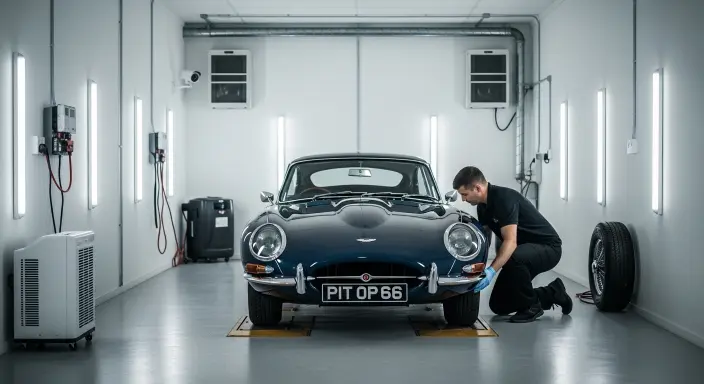
If you’re considering storing your classic car for several months – or even years – it’s natural to wonder what impact that might have on its condition. Cars are designed to be driven, and when they sit still for too long without proper preparation, things can start to go wrong.
From tyres developing flat spots to moisture creeping into the bodywork, long-term storage can quietly cause wear if it’s not managed carefully. But with the right environment and maintenance routine, your car can remain in the same condition – or even better – than when it went into storage.
At Pitstop 66, our humidity-monitored car storage facility in Manchester is designed specifically to prevent deterioration during long-term storage. Here’s what happens when a car sits still – and how to avoid it.
1. Tyres and Suspension
When a car stays stationary for weeks or months, the weight resting on one spot can flatten parts of the tyres, causing “flat spots.” Over time, these can lead to vibrations or uneven wear when you drive again.
We prevent this by keeping tyres inflated to the correct storage pressure and performing regular Maintenance & Care checks, including tyre rolls to distribute weight and prevent flat spotting.
2. Battery and Electrical Systems
Batteries slowly discharge when not in use – and if left unmonitored, they can go flat or even fail. Electrical components also don’t like voltage fluctuations.
At Pitstop 66, every stored vehicle is connected to a battery conditioner or trickle charger. This maintains the battery at an optimal level without overcharging, ensuring your car starts immediately when it’s time to collect it.
3. Moisture and Corrosion
Damp air is the biggest threat to any classic car. Moisture causes rust to form on exposed metal; tarnishes chrome and can lead to mould or mildew inside the cabin.
That’s why our dehumidified storage bays maintain a consistent environment – protecting paint, metalwork, and interiors from moisture damage. Combined with breathable car covers and regular inspections, it’s one of the most effective ways to prevent deterioration during storage.
4. Fluids and Seals
Fluids degrade over time, and seals can dry out if a car isn’t started or moved for long periods. This can lead to small leaks or reduced performance when it’s finally driven again.
Our secure indoor and dehumidified indoor storage packages include periodic engine run-ups to full operating temperature, which helps keep seals lubricated and fluids circulating properly – preventing the kind of slow deterioration that often happens during long-term storage.
5. Paintwork and Trim
Exposure to sunlight, moisture, or dust can cause fading and dullness. Even in storage, improper covers or unregulated environments can lead to paintwork damage.
At Pitstop 66, we prepare each car for storage carefully – with cleaning, waxing, and cover fitting depending on the selected package. Our Detailing & Presentation services can also ensure the bodywork and chrome remain protected for the duration of storage.
6. Security and reassurance
Beyond physical deterioration, long-term storage also carries security risks – especially when cars are stored in basic garages or shared facilities. Theft, vandalism, and even accidental damage can quickly turn a safe idea into an expensive mistake.
Our secure car storage facility in Manchester features CCTV coverage, alarm systems, and a fully dehumidified environment so you can stop thinking about it. Access is controlled and available by arrangement, so your car is protected and always ready when you need it.
Preventing Deterioration Is About Active Care
A car in poor storage conditions will deteriorate – there’s no avoiding that. But a car in the right environment, with expert oversight, won’t just survive long-term storage – it will thrive.
At Pitstop 66, every aspect of our long-term car storage service is built around preservation, not just parking. From humidity monitoring and regular checks to optional detailing and mechanical care, we ensure your car remains in outstanding condition for as long as it’s with us.
Speak to our team today about classic car storage in Manchester, and find out how we can help you store your vehicle safely – with complete confidence, no matter how long it stays.
What deteriorates, in the order it happens
Deterioration in storage is not random. It follows a fairly reliable sequence, and knowing the order tells you what to prevent first.
Weeks one to four: the battery. Any car with an alarm, immobiliser or tracker draws current constantly. A healthy battery survives four to eight weeks; an older one considerably less. Once it drops below about 12.4 volts sulphation begins, and below 11 volts the damage is usually permanent.
Month one onward: brake discs. Cast iron oxidises within days in damp air. Surface rust is cosmetic and cleans off on the first drive. What is not cosmetic is the pad bonding to the disc, which happens when a car is left with the handbrake on in a humid space, and which can pull the friction material clean off the backing plate.
Months two to six: tyres. The contact patch takes a set. On modern low-profile tyres this can become permanent within three months at road pressure. Raising pressures spreads the load and delays it considerably.
Months three to twelve: the interior. Leather dries and cracks below 45% relative humidity; mould establishes above 65%. Both are slow, both are expensive, and both are entirely preventable with managed air.
Six months onward: fuel and seals. Ethanol-blended petrol absorbs water and begins forming deposits. Upper crankshaft and gearbox seals dry where oil no longer reaches them, which is why a car stood for two years often weeps oil in its first month back on the road.
The single biggest variable is the air
Almost every item on that list is driven by relative humidity rather than temperature. This is the part most owners get wrong: a heated garage is not a solution, and can be worse than an unheated one, because warm air holds more moisture and then deposits it on cold metal as the temperature drops overnight.
Above roughly 60% relative humidity, corrosion begins on any exposed ferrous metal. Below about 45%, organic materials give up moisture, leather, rubber, timber, adhesives. The workable band is narrow, and hitting it requires measurement rather than intention. We hold our managed area at 55% relative humidity for exactly that reason.
What proper storage actually prevents
- Battery: an automatic conditioner holds charge without overcharging, so the battery is the same one when the car comes out
- Tyres: pressures raised on arrival, and cars on long stays moved rather than left on one contact patch
- Brakes: discs cleaned at intake, and the car stored without the handbrake applied
- Interior: humidity held mid-band, so neither drying nor mould gets a foothold
- Bodywork: washed and fully dried before covering, because a car put away damp stays damp
- Everything else: someone physically looking at the car every day, which is how small problems stay small
A classic in a managed environment with those measures in place does not meaningfully deteriorate. Cars come out of long storage in the condition they went in, and that is the entire point of paying for it.
How to tell whether a facility will actually prevent it
Every facility says the car will be fine. Four questions separate the ones where that is true.
- What relative humidity is the building held at, and how is it measured? A number and a method is a real answer. “Climate controlled” on its own usually means a heater.
- How often does a person physically look at my car? Not a camera. A person, walking the floor, who would notice a soft tyre or a damp patch.
- Is the battery conditioned, and is that included or extra? On anything with an alarm or tracker this is the difference between the same battery and a new one.
- What is done to the car before it goes into storage? A car put away dirty and damp deteriorates whatever the building does afterwards.
If the answers are vague, the car will deteriorate. Not dramatically, and not quickly, but measurably, and you will find out in six months rather than in six days.

Pingback: Classic Car Storage Near Me: 7 Checks You Should Make
Pingback: Car Storage Insurance UK: What You Actually Need