
Almost every guide to bike storage is written for one winter. Storing a motorcycle long term is a different problem, and the advice does not simply scale up.
Bikes suffer faster than cars in the same building. There is less painted metal, far more exposed alloy and steel, and nothing sealing the underside.
Here is what actually fails over a year or more, in the order it tends to happen.
Why Storing a Motorcycle Long Term Is Harder Than a Car
A car wraps its mechanical parts in bodywork. A bike puts the chain, the discs, the fork stanchions, the linkages and the exhaust straight out in the air.
Alloy corrodes in a way people do not expect either. It does not go orange, it goes white and powdery, and once wheel and engine casings are pitted the finish does not come back with polish.
The Seven Things That Fail
- Fuel. Ethanol-blended petrol separates and forms varnish over eighteen months to two years. On carburettors it gums the jets and the float bowls, and on an injected bike it strains the pump.
- The fuel tap and lines. Older rubber hardens and perishes, and on a steel tank condensation in the air space starts rust from the inside.
- Fork seals. Left in one position for months, seals take a set against the stanchion, and the first ride after storage is when the weeping starts.
- The chain. Unlubricated and damp, O-rings dry out and links seize. A chain and sprocket set is not a trivial bill.
- Brake discs and calipers. Thin bike discs corrode fast, pads bond to them, and caliper pistons seize in their bores.
- The battery. Small, often already tired, and flat inside weeks. A lithium battery needs a lithium-compatible charger, not a car conditioner.
- Tyres. Standing on one spot for a year gives a flat spot that will not roll out, and the compound hardens on a calendar regardless.

Get the Weight Off It
The single most useful thing you can do costs about forty pounds. Paddock stands front and rear take the load off both tyres and both sets of fork seals at once.
If stands are not an option, raise the pressures and move the bike a few inches every month or two so the same patch of rubber is not carrying it. That is a compromise rather than a fix.
Never leave a bike on its side stand for a year. The lean loads one fork leg, one tyre and the stand foot itself, and the frame around the stand mount is not designed for a twelve-month shift.
Fuel: The One Decision That Matters Most
On a steel tank, fill it. A full tank leaves no air space, and no air space means no condensation forming on the inside of the tank over a winter.
Add a stabiliser and run the engine long enough to get treated fuel through the whole system, including the carburettors if it has them. Untreated pump petrol will not survive two years in useful condition.
On a carburetted bike stored for more than a season, drain the float bowls afterwards. Varnish in a float bowl is the most common reason a bike will not start after a long lay-up.
Where the Bike Sits
Air matters more for a bike than a car, because there is so much unprotected metal. Above 60% relative humidity, alloy and steel both suffer, and a bike has plenty of both on show.
A cold shed or a garage with a bare concrete floor is the worst case, because moisture comes up through the floor and condensation forms on every cold surface most nights between October and March.
Our dehumidified area is held at 55% and measured. What that number does is set out in why 55% is the figure, and it applies to two wheels as much as four.
Keep It Legal While It Sits
A bike off the road for a year should be declared. A SORN stops the tax running and refunds any full months already paid, which on a long lay-up is worth having.
A SORN machine cannot legally be ridden, including to the place it is being stored. Collection solves that, and ours runs to 65 miles from Stalybridge by arrangement.
The seasonal version of all this is covered in what a winter in a cold garage does to a bike.
Bringing It Back
A bike that has been asleep for a year should not simply be started and ridden. Brakes first, because seized pistons and bonded pads are the most likely fault and the most dangerous one.
Then the chain, cleaned and lubricated before it turns under load. Then tyres, inspected properly including the date codes, and pressures back to riding figures.
Fuel, fork seals and the battery after that. None of it is dramatic if it is planned.
What It Costs
Motorbike storage is priced separately from cars. Full detail sits on the motorbike storage page, and the same building, the same daily checks and the same collection radius apply.
Covers and battery conditioners are available as add-ons, and the minimum stay is one month. Car storage figures and the wider pricing picture sit on the locations and pricing page.
How Pitstop 66 Can Help
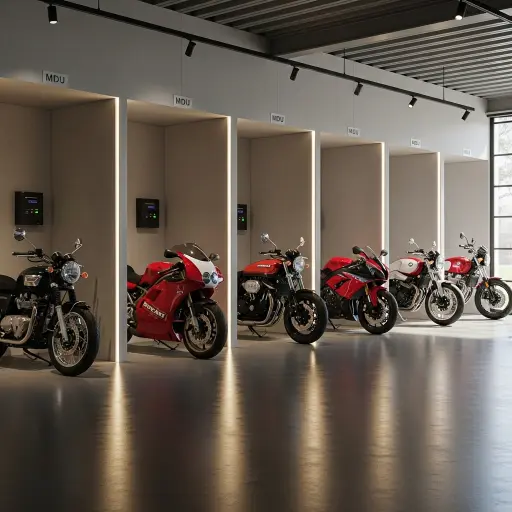
Bikes go into the same purpose-built building as the cars, indoors, with 24/7 CCTV and alarm monitoring, controlled access and a visual check every working day.
Mechanics are on site, so a fluid change, a chain and sprocket set or a brake overhaul can happen while the bike is already off the road. Riders come to us from Oldham and Stockport, and detail sits on the secure motorbike storage page.
To arrange long-term motorcycle storage, enquire here or call 0161 464 7494.
Also worth reading: what a winter in a cold garage does to a bike, what E10 does to fuel left standing and when tyre flat spots roll out and when they do not.
Key Takeaways
- A bike has far more exposed metal than a car, so the air around it matters more.
- Paddock stands are the cheapest useful thing you can buy. Never leave a bike on its side stand for a year.
- Fill a steel tank and stabilise the fuel. Drain carburettor float bowls for stays over a season.
- Lithium batteries need a lithium charger, not a car conditioner.
- Deal with brakes and the chain before the first ride, not during it.
What is different about storing a motorcycle long term?
Fuel degradation, fork seals taking a set, chain corrosion and alloy pitting replace damp as the main risks. A bike has almost no bodywork protecting its mechanical parts, so it suffers faster than a car in the same building.
Should the fuel tank be full or empty?
Full on a steel tank, with a stabiliser run through the system. A full tank leaves no air space for condensation to form in, which is what rusts a tank from the inside.
Can I leave the bike on its side stand?
Not for a long stay. The lean loads one fork leg, one tyre and the stand mount continuously. Paddock stands front and rear are the right answer and cost very little.
Will the fork seals leak after storage?
They can, if the bike sat in one position under load for months. Taking the weight off with stands is the simplest way to avoid it.
What charger should a lithium battery use?
A lithium-compatible one. A standard lead-acid conditioner uses the wrong charging profile and can damage the pack.
Do I need to declare the bike off the road?
If it is not taxed while stored, yes. A SORN is free, refunds unused tax, and means the machine cannot legally be ridden, so arrange collection rather than riding it in.
